
 11
11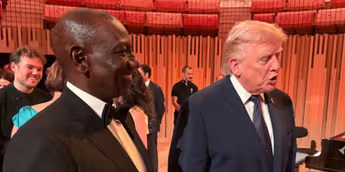
Kenya’s President William Ruto announced the deal on the sidelines of the G7 summit in France, highlighting Kenya’s push to reshape how it monetises its natural resources.
The agreement centres on the Mrima Hill deposit in Kwale County and requires that all strategic minerals be processed domestically, a major shift from the traditional export of raw materials.
William Ruto told Reuters that the agreement covering rare earths and other strategic minerals was already in advanced discussions and could be concluded soon, as Kenya moves closer to securing a landmark minerals partnership with the United States.
“We have agreed that the minerals will be processed in Kenya,” he said, following talks with G7 leaders, including U.S. President Donald Trump, adding that the arrangement reflects a shared push for local value addition rather than raw exports.
The Kenya deal highlights the deepening rivalry between the United States, China and Russia over Africa’s mineral wealth, as global powers race to secure inputs vital for clean energy systems, advanced manufacturing and defence technologies.
China remains the dominant player in mineral processing and supply chain control across Africa, giving Beijing long-standing leverage in global markets.
The United States, however, is increasingly pursuing bilateral agreements that prioritise supply security and domestic value addition within partner countries.
Russia has also expanded its presence through security-linked mining arrangements in countries such as Mali and the Central African Republic, where access to resource-rich concessions has become part of its broader geopolitical strategy.
Beyond Kenya, Washington has pursued similar critical minerals partnerships in the Democratic Republic of Congo, where cobalt and copper are central to global battery production.
These arrangements reflect a broader shift by African governments demanding local processing and greater value retention.
For the United States, securing rare earths is essential to reducing reliance on China’s dominance in refining. China seeks to maintain that dominance, while Russia continues to position itself as an alternative partner across Africa’s resource corridor.
Kenya’s agreement reflects a wider realignment in how African mineral wealth is negotiated in an increasingly competitive global order.
Solomon Ekanem